

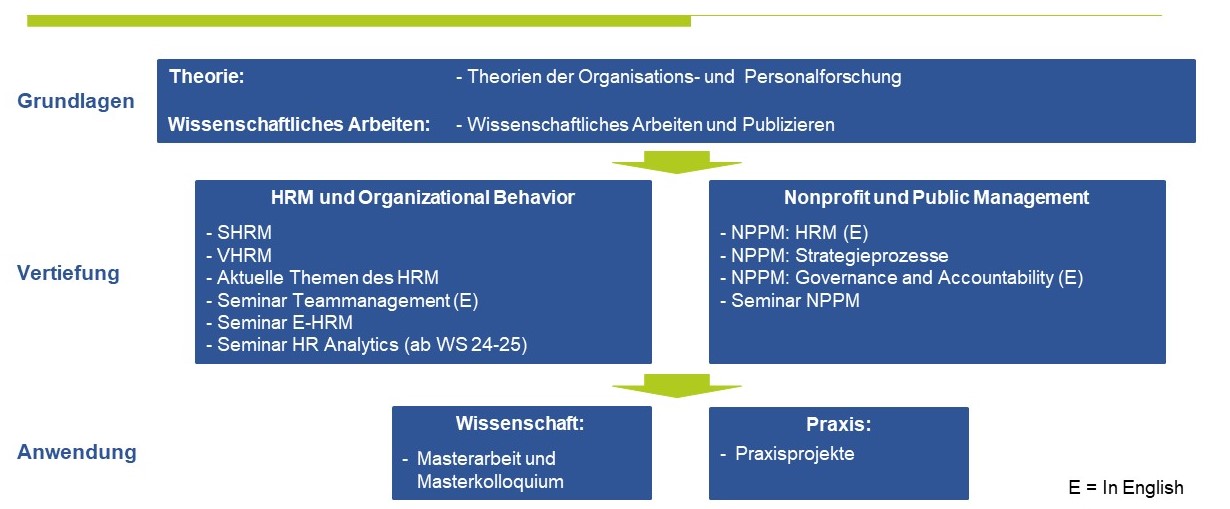
Teaching courses offered by the Institute of Human Resource Management and Organizational Behavior

All teaching courses in the following tables are described in the announcements by semester. For seminars, detailed additional information is available in the form of profiles on the linked pages.

Overview Bachelor

Compulsory Program

Modul / Veranstaltung Empf. Fach­semester Sprache Semester
BWL II (Teilmodul Personal) 2 Deutsch Sommer

Area BWL

Modul / Veranstaltung Empf. Fach­semester Sprache Semester
Non Profit und Public Management 5 Deutsch Winter
Seminar: Organizational Behavior 5 Deutsch Winter

Overview Master

Area Strategic Management

Modul / VeranstaltungEmpf. Fach­semesterSpracheSemester
Qualitative Management Research 11EnglischWinter
Aktuelle Themen des Human Resource Managements1-3DeutschWinter
Nonprofit and Public Management: Human Resource Management1-3EnglischWinter
Nonprofit und Public Management: Strategieprozesse1-3DeutschWinter
Strategisches Human Resource Management3DeutschWinter
Theorien der Organisations- und Personalforschung1-3DeutschWinter
Verhaltenswissenschaftliche Grundlagen des HRM2DeutschSommer
Wissenschaftliches Arbeiten und Publizieren:
Forschungskolloquium Personal und Arbeit
2DeutschSommer
Seminar E-HRM2DeutschSommer
Seminar Nonprofit und Public Management2DeutschSommer
Seminar Teammanagement1-3EnglischWinter
Seminar Entrepreneurial Finance (Prof. Kleinert)1-3EnglischSommer
Seminar Entrepreneurial Ecosystems (Prof. Kleinert)1-3EnglischSommer
Entrepreneurship Theorie und Praxis (Prof. Kleinert)1-3DeutschSommer
Praxisprojekte (findet zurzeit nicht statt)2DeutschSommer

Our Teaching Courses in the Master's program in Economics

Übersicht Nebenfach

Betriebswirtschaftslehre

Modul / Veranstaltung Empf. Fach­semester Sprache Semester
Betriebswirtschaftslehre I   Deutsch Winter
Betriebswirtschaftslehre II   Deutsch Winter
Betriebswirtschaftslehre III   Deutsch Sommer
Betriebswirtschaftslehre IV   Deutsch Sommer

Course announcements by semester

  • Winter term2026/2027

    Bachelor Economics and Management

    Area of Expertise in Business Administration

    • Seminar: Organizational Behavior (271076)

      Time and room:Lecturer:
      Block courseHilmer
      Contents:

      The seminar provides insights into the fundamental determinants of behavior in organizations and enables participants to address a scientific problem and to write an independent academic paper. Based on conceptual and empirical findings, key influencing factors at the individual, group, and organizational levels are examined, and the interrelations between these levels are highlighted. Participants will learn to understand organizational behavior as a complex phenomenon and critically engage with the question of which levers organizations can use to shape and influence the behavior of their members.

      As part of the group work, participants are expected to address questions related to the following areas:

      • Individual level (e.g., personality, perception, motivation, attitudes, behavior)

      • Group level (e.g., communication, decision-making processes, leadership, power and micropolitics)

      • Organizational level (e.g., organizational structures, organizational identity, organizational change)

      Literature:

      Robbins, S. P., & Judge, T. A. (2012) Organizational Behavior, 15th Edition, Prentice Hall.

      Comments:

      The exact dates as well as information on registration will be announced through the respective information channels of the institutes.

      The following course assessments are to be completed in groups (group size = 2-3):

      • Term paper (15 pages ±10%): 60%
      • Presentation of the term paper (approx. 20 minutes presentation and 15 minutes discussion): 30%
      • Co-presentation on another group’s paper (approx. 5 minutes feedback): 10%

      Regular attendance at all seminar sessions is strongly recommended, as the introductory meetings provide an essential foundation for understanding the subject matter and for developing academic working skills. In addition, the block sessions include the presentations, which form part of the course assessment.


    Master Economics and Management

    Area Strategic Management

    • Strategic Human Resource Management (378011)

      Time and room:Lecturer:
      Thu. 16:15 - 17:45 | I-342Piening
      Contents:
      • Human Resources Strategies
      • Work Design
      • Strategic Workforce Planning and Talent Management
      • Recruitment and Selection
      • Performance Management
      • Employee Development
      • Compensation and Incentive Design
      Literature:
      • Ridder, H.-G. (2015) Personalwirtschaftslehre. 5. Auflage. Stuttgart. Kohlhammer.
      • Wright, P. M., & McMahan, G. C. (1992) Theoretical perspectives for strategic human resource management. Journal of Management, 18(2), 295-320.
      • Delery, J. E., & Roumpi, D. (2017) Strategic human resource management, human capital and competitive advantage: is the field going in circles?. Human Resource Management Journal, 27(1), 1-21.
      • Jiang, K., & Messersmith, J. (2018) On the shoulders of giants: A meta-review of strategic human resource management. The International Journal of Human Resource Management, 29(1), 6-33.
      Comments:

      Participants are expected to work on practical case studies in groups and present them during the course. The written report and presentation of the case study account for 50% of the grade. The remaining 50% is based on individual performance, which is assessed through short quizzes during class and a written assignment.

      Enrollment in the course is limited to 32 students.

    • Organization and Human Resource Management Theories (378062)

      Time and room:Lecturer:
      Thu. 12:45 - 14:15 | I-301Piening
      Contents:
      • Klassische Organisationstheorien
      • Verhaltenswissenschaftliche Entscheidungstheorie
      • Situativer Ansatz
      • Neue Institutionenökonomik
      • Evolutionstheoretische Ansätze
      • Neo-Institutionalismus
      • Intepretative Theorien (z.B. Organisationskulturen)
      • Psycholgische und sozialpsychologische Theorien
      • Strategische Managementtheorien
      Literature:

      Kieser, A. & Ebers, M. (2019) Organisationstheorien, 8. Aufl., Stuttgart et al.

      Perrow, C. (1973) The short and glorious history of organizational theory. Organizational Dynamics, 2(1-Summer): 3-15.

      Comments:

      All students who wish to take the advanced courses offered by the institute are strongly encouraged to first complete the introductory course “Theories of Organizational and Human Resource Research.”

    • Seminar Team Management (378063)

      Time and room:Lecturer:
      Block courseKandel
      Contents:
      • Types of teams (e.g., virtual and temporary teams)
      • Team design (e.g., diversity)
      • Team leadership
      • Cohesion, trust, and identification in teams
      • Negative aspects of teamwork (e.g., conflicts)
      • Outcomes of teamwork (e.g., innovation)
      Literature:
      • Robbins, S. P., & Judge, T. A. (2018) Organizational Behavior, 18. Aufl., Prentice Hall.
      • Mathieu, J., Maynard, M. T., Rapp, T.; Gilson, L. (2008) Team effectiveness 1997-2007: A review of recent advancements and a glimpse into the future. Journal of Management, 34(3), 410-476.
      • Mathieu, J. E., Gallagher, P. T., Domingo, M. A., & Klock, E. A. (2019). Embracing complexity: Reviewing the past decade of team effectiveness Research. Annual Review of Organizational Psychology and Organizational Behavior, 6, 17–46.
      Comments:

      The exact dates and registration information will be announced via the respective information channels of the institutes.

      The following examination requirements must be completed in group work (group size = 2-3):

      • Coursework essay (15 pages (group of 2) / 20 pages (groups of 3) +/- 10%): 60%
      • Presentation of the essay (approx. 20 minutes presentation and 15 minutes discussion): 30%
      • Co-presentation on the essay of another group (approx. 5 minutes feedback): 10%

      Students are expected to attend all seminar dates.

    • Management & Society (378064)

      Time and room:Lecturer:
      Block courseBaluch
      Contents:

      The way that people understand everyday life in organisations and how they make sense of organisations’ role in society are subjects that have generated a considerable volume of scholarship. The purpose of this colloquium is to enable students to understand significant contemporary debates pertaining to “Management & Society”, to evaluate organisations and the responses of their employees, and to critically appraise what responsible management means in their own organisational lives.
      Indicative topics covered in this course include:

      Introduction:

      • The Context for Managing
      • Employee Relations

      Grand Challenges:

      • I: AI in Recruitment and Selection
      • II: Responsible Management and Performance
      • III: Sustainability in Work and HRM

      Critical Management Studies:

      • I: Corporate Culture
      • II: Space, Power and Identity
      • III: Teamworking and Control
      • IV: Emotional Labour
      • V: Obedience and Ethics
      • VI: Workplace Resistance
      Literature:

      A reading list with journal articles and book chapters will be issued to registered participants in advance of the module.

      Comments:

      The course is limited to 20 participants. Registration is a multi-step process. (1) Please register in the Stud.IP course. (2) There you will receive further information about the registration through a form. (3) If more than 20 participants register, places will be allocated by a draw.

      The course will comprise of a 5-day colloquium (19.10.-23.10.2026) in which relevant contemporary issues in "Management & Society" are presented and discussed by the students. Students will be assigned topics including key readings and prepare a presentation on their assigned topic. The preparation time is the same for each student. After the course, each student will write a short reflective essay piece of 750 words on their learning experience.

    • Technology and Innovation Management (378070)

      Time and room:Lecturer:
      Wed. 11:00 - 12:30 | I-301Kleinert
      Contents:

      In this course the students will gain in-depth knowledge of strategies, practices, and theories in technology and innovation management including such topics as types of innovation, sources of innovation, timing of innovation, s-curves, crowdsourcing, design thinking, open innovation, technology portfolio management, and stage-gate model. Additionally, they will have the opportunity to apply their learnings in various case studies and discuss them with guest lecturers from practice.

      Literature:
      • Cohen, W. M., & Levinthal, D. A. 1990. Absorptive Capacity: A New Perspective on Learning and Innovation. Administrative Science Quarterly, 35(1): 128-152.
      • Teece, D. J. 1986. Profiting from technological innovation: Implications for integration, collaboration, licensing and public policy. Research Policy, 15(6): 285-305.
      • Eisenhardt, K. M., & Martin, J. A. 2000. Dynamic capabilities: what are they?. Strategic Managament Journal, 21(10-11): 1105-1121.
      • March, J. G. 1991. Exploration and exploitation in organizational learning. Organization Science, 2(1): 71-87.
      • Pollok, P., Lüttgens, D., & Piller, F. T. 2019. Attracting solutions in crowdsourcing contests. Research Policy, 48: 98-114.
      • Schilling, M. A. 2023. Strategic management of technological innovation (Vol. 7). New York: McGraw-Hill/Irwin.
      Comments:

      This course was formerly entitled “Innovation Management III”. Students that attended “Innovation Management III” are not eligible for this course.

    • Current Topics in Human Resource Management (378077)

      Time and room:Lecturer:
      Wed. 14:30 - 16:00 | I-332Zentgraf
      Contents:

      The central focus of the course is the exploration of what work means for us as individuals, how this meaning has changed over the past decades, and how we envision the future of work. The course further addresses the challenges and opportunities associated with new forms of work, as well as how New Work is currently implemented within economic and societal systems, and how it might be shaped in the future.

      Thematic blocks will cover, among others, the following areas:

      • Models of (self-)organization and leadership

      • Workplace and working-time design

      • Compensation and incentive systems

      • New Work in the macro context of economy, politics, and society

      Literature:

      Delbridge, R., & Sallaz, J. J. (2015) Work: Four worlds and ways of seeing. Organization Studies, 36(11), 1449-1462.

      Leslie, L. M., King, E. B., & Clair, J. A. (2019) Work-life ideologies: The contextual basis and consequences of beliefs about work and life. Academy of Management Review, 44(1), 72-98.

      Parker, S. K., & Grote, G. (2022) Automation, algorithms, and beyond: Why work design matters more than ever in a digital world. Applied Psychology. 71(4), 1171-1204.

      Comments:

      The exact dates, schedule as well as information on registration will be announced through the respective information channels of the institutes. The number of participants is limited to a maximum of 28.

      The course assessment consists of both a group component and an individual component. Participants are expected to work in groups on practice-oriented case studies and present their results during the course. The group presentation of the case study account for 50% of the final grade.

      The remaining 50% is based on individual performance, assessed through short tests during the course sessions and an additional written paper.

      The language of instruction is German. Students are expected to be able to understand, contextualize, and critically engage with more advanced English-language texts. The written paper may be submitted in either German or English.

    • Digital Innovation (378090)

      Time and room:Lecturer:
      Block courseSchlüter
      Contents:

      This course provides an overview of digital innovations, especially artificial intelligence (AI), and gives students in-depth insights into its application in organizations.

      The focus is on understanding the theoretical underpinnings, underlying methodology, and general mindset necessary to make sense of AI in organizations and agile environments.

      In this course, students will have the opportunity to learn about methods relevant to real-world applications and apply them in a case study. For this purpose, they identify a problem and conceptually develop an AI-supported solution approach in groups using agile methods such as iterative development and regular feedback loops.

      The course format includes a mix of classical lectures (theoretical basics), agile idea development (application), and presentations.

      Literature:

      Akerkar, R. (2019). Artificial Intelligence for Business. Springer

      Comments:

      Content: In this module, participants work in groups of 3-5 members to jointly identify a problem and conceptually develop an AI-supported solution approach. The results are then presented, discussed and recorded in the form of a presentation. The workshop thus prepares participants for a possible position as digital innovation manager, data scientist or technology entrepreneur after graduation.

      Exam: The examination will be a presentation and discussion.

      Registration: The course is limited to 20 participants. Registration is a multi-step process. (1) Please register in the Stud.IP course. (2) There you will receive further information about the registration through a form. (3) If more than 20 participants register, places will be allocated by drawing.

      Miscellaneous: The course starts with a two-day block to introduce the topics. Afterwards, there is a three-week working phase in which coaching sessions take place in groups. Finally, the results are presented, discussed, and codified.

    • Venture Lap (378100)

      Time and room:Lecturer:
      Block courseAhlers, Kleinert
      Contents:

      This course offers in-depth insights into the commercial exploitation of technologies. The starting point is not a market idea, but a real patent. Participants are assigned a technology in teams, develop potential business ideas, and evaluate them.
      The focus is on determining which market a technology is actually suited for. Since a technology can typically be configured for a wide variety of applications, the teams first identify a broad range of possible application areas, systematically evaluate them, and make a well-reasoned decision in favor of one. The selected market opportunity is then translated into a business model and assessed for its viability.
      The course concludes with a presentation and a written report.

      Content: In this module, participants work in groups of three members on a real technology. They identify possible fields of application, select one with justification, develop a business model for it and test and validate its central assumptions. The results are presented, discussed and documented in writing. The course thus prepares participants for roles in technology transfer, innovation management and early-stage financing, as well as for founding a technology-based venture of their own.

      Comments:

      Exam: The examination consists of a presentation and a written assignment, both of which are completed as group work.

      Registration: The course is limited to approximately 20 participants. Registration is a multi-step process: (1) Please register in the Stud.IP course. (2) There you will receive the registration form with all further information. (3) If more than 20 participants register, places will be allocated by drawing.

      Miscellaneous: The course consists of block sessions, coaching sessions and presentation dates. In order to allow for intensive team work, participation in all sessions is required. If you cannot ensure this, we kindly ask you to leave your place to other students.

    • Seminar Entrepreneurship and Grand Challenges (378101)

      Time and room:Lecturer:
      Block courseHeinze
    • Seminar Digital Business and AI (378102)

      Time and room:Lecturer:
      Block courseKleinert
    • Build, Buy, Spin-off: Corporate Innovation in Practice (378103)

      Time and room:Lecturer:
      Block courseSchiemann
      Contents:

      Why would an industrial conglomerate split into three independent companies? And why would a market leader acquire a startup that it could just as easily have built itself? Such decisions are among the most far-reaching in corporate innovation management—and are the focus of this colloquium.
      Established companies must continually decide how to tap into new business areas: build them internally (Build), acquire them or develop them through partnerships (Buy/Borrow), or spin them off as independent companies (Spin-off). From the perspectives of the corporation, the investor, and the consultant, this event covers the strategic, organizational, and financial fundamentals of this decision—in a practical, case-based manner, with a special focus on spin-offs. Topics covered include:

      • Corporate innovation and the “Build–Buy/Borrow–Spin-off” decision-making framework
      • Internal corporate venturing, intrapreneurship, and organizational ambidexterity
      • M&A for innovation, corporate venture capital, alliances, and joint ventures
      • Spin-offs and carve-outs: drivers, mechanics, governance, and impact on value
      • Application to a realistic, anonymized case study in group work, culminating in a final pitch

      In this way, students develop a toolkit that can be directly applied in roles in strategy, M&A, corporate development, innovation consulting, or venture capital

    Nebenfachstudium

    • Principles of Business Administration I (for non-business majors) (76001)

      Time and room:Lecturer:
      Thu. 16:15 - 17:45 | VII-003Zentgraf
      Contents:
      • Grundbegriffe der Betriebswirtschaftslehre
      • Unternehmen und Märkte
      • Unternehmertum, Unternehmensführung und Unternehmenserfolg
      • Strategisches Management
      Literature:

      Aktuelle Informationen (Semestertermine, Themenübersichten, Literatur) werden jeweils zu Beginn des Semesters über Stud.IP bereitgestellt.

      Comments:

      Die Modulprüfung ist eine Klausur (60 Minuten) und findet im Regelfall in der letzten Vorlesungswoche statt. Bei Nichtbestehen besteht die Möglichkeit zur Wiederholung im nachfolgenden Semester. Informationen zum Anmeldeverfahren für die Prüfung werden über Stud.IP bereitgestellt. Studienleistungen (z.B. Referate) werden nicht angeboten.

    • Principles of Business Administration II (for non-business majors) (76002)

      Time and room:Lecturer:
      Fri. 10:15 - 11:45 | I-301Zentgraf
      Contents:
      • Konzeptionelle Grundlagen des Marketings
      • Marktorientierte Unternehmensführung
      • Marktforschung
      • Absatzpolitische Instrumente des Marketings
      Literature:

      Aktuelle Informationen (Semestertermine, Themenübersichten, Literatur) werden jeweils zu Beginn des Semesters über Stud.IP bereitgestellt.

      Comments:

      Die Veranstaltung findet von 10:15-11:45 statt.

      Die Modulprüfung ist eine Klausur (60 Minuten) und findet im Regelfall in der letzten Vorlesungswoche statt. Bei Nichtbestehen besteht die Möglichkeit zur Wiederholung im nachfolgenden Semester. Informationen zum Anmeldeverfahren für die Prüfung werden über Stud.IP bereitgestellt. Studienleistungen (z.B. Referate) werden nicht angeboten.

  • Summer term 2026

    Bachelor Economics and Management

    Area of Expertise in Business Administration, Business Administration II

    • HRM Tutorial (270060)

      Time and room:Lecturer:
      Mon. 09:15 - 10:45 | II-013 (Group 1)Tutor
      Tue. 14:30 - 16:00 | VII-002 (Group 2)Tutor
      Wed. 11:00 - 12:30 | VII-002 (Group 3)Tutor
      Thu. 09:15 - 10:45 | VII-005 (Group 4)Tutor
      Fri. 11:00 - 12:30 | I-401 (Group 5)Tutor
      Contents:

      This is a supplementary tutorial. The content from the lecture will be reviewed and discussed. In-depth questions will be addressed on selected topics.

      Literature:

      Ridder, H.-G. (2015) Personalwirtschaftslehre, 5. Auflage, Stuttgart u.a.

      Comments:

      Further information about the event schedule is available at Stud.IP.

      Group registration opens on Stud.IP: Monday 13 April 2026 at 4.30 pm.

    • Human Resource Management (270175)

      Time and room:Lecturer:
      Mon. 12:45 - 14:15 | VII-201 (Group 1)Piening
      Mon. 12:45 - 14:15 | VII-002 (Group 2)Piening (Video)
      Contents:

      The Fundamentals of Human Resource Management cover the following key Topics:

      • Strategic HRM
      • Personnel planning
      • Recruitment
      • Staff reductions
      • Personnel development
      • Personnel management
      Literature:

      Ridder, H.-G. (2015) Personalwirtschaftslehre, 5. Auflage, Stuttgart u.a.

    Area of Expertise in Business Administration

    • Strategic IT-Management (271081)

      Time and room:Lecturer:
      Contents:

      TBA

      Literature:

      TBA

    Master Economics and Management

    Area Strategic Management

    • Seminar Nonprofit and Public Management (378001)

      Time and room:Lecturer:
      Wed. 12:45 - 16:00 (Every 14 days) | VII-004Bruns
      Contents:

      The event focuses on the question of how problem areas and objectives of strategic action by non-profit institutions are characterized in key concepts of strategic non-profit and public management (non-profit governance, public service accountability, public service motivations).

      On this basis, an analysis will be conducted of why the logic of strategic management concepts is “watered down” by the complex characteristics of public and social services, thereby jeopardizing the credibility of political and/or social measures.

      The conceptualization of these strategic processes, their influencing factors, and effects enables students to critically examine the content and methodological requirements of writing a scientific thesis

      Literature:
      • Van Thiel, S. (2014). Research Methods in Public Administration and Public Management: An Introduction. Routledge: London, New York.
      • Abbott, A. D. (2004). Methods of Discovery. Heuristics for the Social Sciences. W.W. Norton & Company, New York, London.

      Further information about the event will be provided on the institute's website and via Stud.IP.

      Comments:

      It is recommended that students successfully complete the module Theories of Organizational and Human Resource Research and one of the methodology modules (e.g., Qualitative Management Research I or II) before participating.

      The following examination requirements must be completed in group work (group size = 2):
      • Term paper (15 pages +/- 10%): 70%
      • Presentation of the term paper (approx. 20 minutes and 15 minutes of discussion): 30%

      Registration for the seminar will take place from March 1-15, 2026, via a web form.

    • Qualitative Management Research 1 (378007)

      Time and room:Lecturer:
      Tue. 09:15 - 10:45 | VII-002Kandel
      Contents:

      The course provides insights into qualitative research methods in management and organization studies. Designed as an introductory course, the class guides students through the various stages involved in designing and conducting qualitative research studies. The syllabus includes foundations of qualitative research, types of qualitative research, sampling, data collection, and data analysis, theorizing from qualitative data, and writing up qualitative research. Throughout the course students are expected to critically reflect on different approaches to qualitative research as well as the role of the researcher(s) in the research process. As part of the class, students will have to demonstrate their knowledge and application of qualitative research methods through in-class exercises and tests. Students will also have the opportunity to conduct their own research.

      Literature:
      • Bansal, P. (Tima), Smith, W. K., & Vaara, E. (2018). New ways of seeing through qualitative research. Academy of Management Journal, 61(4), 1189–1195.
      • Gehman, J., Glaser, V. L., Eisenhardt, K. M., Gioia, D., Langley, A., & Corley, K. G. (2018). Finding theory–method fit: A comparison of three qualitative approaches to theory building. Journal of Management Inquiry, 27(3), 284–300.
      • Patton, M. Q. (2015). Qualitative research & evaluation methods: Integrating theory and practice (Fourth edition). SAGE.
    • Entrepreneurship Theory and Practice (378027)

      Time and room:Lecturer:
      Wed. 16:15 - 17:45 | I-401Kleinert
      Contents:

      This course introduces the fundamentals of entrepreneurship and demonstrates how entrepreneurial thinking and action can be systematically understood and applied. Participants will explore concepts such as entrepreneurial decision-making processes, the development and analysis of business models, and the identification and evaluation of opportunities and risks. Other topics include founder personalities, the lean startup approach, digital startups and their business models, sources of financing, and methods for evaluating young companies. By combining theory and practice, participants acquire the ability to develop startup and innovation projects in a structured manner, reflect on them critically, and implement them in real-world contexts.

    • Seminar Entrepreneurial Finance (378042)

      Time and room:Lecturer:
      Block courseKleinert
      Contents:

      This seminar prepares students to conduct quantitative research in entrepreneurship and entrepreneurial finance and serves as a foundation for writing a master’s thesis in this area. It introduces how start-ups obtain funding in environments of high uncertainty and limited access to traditional bank financing, covering key financing instruments such as venture capital, business angels, private equity, crowdfunding, and IPOs.

      By linking the content on new venture financing with methodological training, students learn to formulate research questions in this field, develop and test hypotheses using quantitative data, conduct empirical analyses, and write an academic paper on topics related to entrepreneurial finance.

      Comments:

      The following examination requirements must be completed in group work (group size = 2):

      • Term paper (15 pages +/- 10%): 70%
      • Presentation of the term paper (approx. 20 minutes and 15 minutes of discussion): 30%

      Registration for the seminar will take place from March 1-15, 2026, via a web form.

    • Seminar Entrepreneurial Ecosystems (378043)

      Time and room:Lecturer:
      Block courseHeinze
      Contents:

      This seminar offers an introduction to entrepreneurial ecosystems and the systemic conditions that enable the emergence and growth of new ventures. Since entrepreneurship is embedded in broader institutional and economic contexts, the seminar examines the key elements that shape an ecosystem, including institutions, networks, human capital, support structures, cultural norms, and access to finance. Students learn how these elements interact, how entrepreneurs draw on their local environment, and why some regions show stronger entrepreneurial activity than others. Using leading theoretical frameworks and scientific articles, the seminar analyzes how actors such as founders, investors, universities, corporations, and policymakers co-create the ecosystem in which entrepreneurship unfolds. The seminar also prepares students for writing a master thesis on topics related to entrepreneurship and entrepreneurial ecosystems.

      Comments:

      The following examination requirements must be completed in group work (group size = 2):

      • Term paper (15 pages +/- 10%): 70%
      • Presentation of the term paper (approx. 20 minutes and 15 minutes of discussion): 30%

      Registration for the seminar will take place from March 1-15, 2026, via a web form.

    • Master-Colloquium (378058)

      Time and room:Lecturer:
      Block coursePiening
      Contents:

      Students writing their master's thesis at the Institute for Personnel and Organizational Behavior present their topic and current progress (e.g., research question, study design) for discussion as part of the master's colloquium. The aim of this interactive block seminar is to identify potential problems in the conception and implementation of the thesis at an early stage and to provide master's students with guidance for the rest of their work. In addition to the presentation in the master's colloquium, students are required to prepare a written paper of approximately three pages on their research question and research concept (exposé

      Comments:

      The institute supervises master's theses on current issues in the areas of 1) human resource management and organizational behavior, 2) innovation and learning, and 3) nonprofit and public management. Students have the option of either working on a predetermined topic (a list of topics is announced before each registration phase) or, after prior consultation, a topic of their own choosing. Both empirical (e.g., in cooperation with companies) and conceptual theses are possible.

      If you would like to write your master's thesis at the Institute for Human Resources and Organizational Behavior, you can apply for a place each year from 01.01.-21.01. as part of the central registration process for the Strategic Management Area. In your application, you can indicate whether you would like to write your master's thesis in the summerterm (starting on April 1) or in the winterterm (starting on October 1).

      The master's colloquium will take place in the summerterm 2026 as an external block event from May 27 to May 29, 2026, in Altenau.

    • Research Colloquium Human Resource Management (378066)

      Time and room:Lecturer:
      Block coursePiening
      Contents:

      Publication process:

      • International journals: How do they work, how does the review process work, and which journal is right for my paper?
      • Dealing with reviewer comments

      Planning your own publication:

      • Problem definition and research question
      • Theoretical foundation
      • Research design
      • Discussion of theoretical and practical implications
      Literature:
      • Colquitt, J. A., & George, G. (2011). Publishing in AMJ: Topic choice. Academy of Management Journal, 54: 432–435.
      • Bono JE, McNamara G. (2011). From the editors: Publishing in AMJ-part 2: Research design. Academy of Management Journal, 54, 657–660.
      • Grant, A. M. & Pollock, T.G. (2011). Publishing in AMJ-Part 3: Setting the hook. Academy of Management Journal, 54,873-879.
      • Sparrowe, R. T., & Mayer, K. J. (2011). Publishing in AMJ-Part 4: Grounding hypotheses. Academy of Management Journal, 54: 1098-1102.
      • Zhang, Y., & Shaw, J. D. (2012). From the editors: Publishing in AMJ-part 5: Crafting the methods and results. Academy of Management Journal, 55: 8–12.
      • Geletkanycz, M., & Tepper, B. J. (2012). Publishing in AMJ-Part 6: Discussing the implications. Academy of Management Journal, 55: 256–260.
      • Bansal, P., & Corley, K. G. (2012). From the Editors-Publishing in AMJ-Part 7: What’s different about qualitative research? Academy of Management Journal, 55, 509–513.
      Comments:

      The course is aimed at students who are writing or planning to write their master's thesis at the Institute for Human Resources and Organizational Behavior.

      The examination consists of a written paper on one of the topics covered in the course.

    • Behavioral Foundations of Human Resource Management (378067)

      Time and room:Lecturer:
      Mon. 16:15 - 17:45 | I-342Piening
      Contents:

      The aim of the course is to provide students with in-depth insights into the behavioral science fundamentals of human resource management. Participants will learn about basic concepts, theories, and empirical findings in the field of organizational behavior research. Through a better understanding of the factors that influence individual and collective behavior in organizations, they will be able to analyze human resource issues in a differentiated manner and develop context-specific solutions. In group work, they will work on and present practical case studies on current behavioral science topics in human resources (e.g., motivation, leadership, and team management).

      Literature:

      Robbins, S. P., & Judge, T. A. (2012). Organizational Behavior, 15. Aufl., Prentice Hall.

      Comments:

      Participants are expected to work in groups to complete practical case studies and present them during the course. The written report and presentation of the case study account for 50% of the grade. The remaining 50% is based on individual performance, which is assessed through short tests during the course and a written report.

      The number of participants in the course is limited to 40.

    • Seminar E-HRM (378068)

      Time and room:Lecturer:
      Block courseKandel, Zentgraf
      Contents:

      The ongoing digitalization of the economy is associated with comprehensive changes in corporate human resources management. Digital technologies offer a wide range of potential for more effective recruitment, selection, development, and assessment of employees. However, e-HRM is not just about digitizing various HR functions. Rather, the goal for companies should be the systematic collection, structuring, and analysis of large amounts of data (“big data”) and the integration of this data into HR and corporate planning.

      Literature:
      • Strohmeier, S. (2007). Research in e-HRM: Review and implications. Human Resource Management Review, 17(1), 19-37.
      • Marler, J. H., & Fisher, S. L. (2013). An evidence-based review of e-HRM and strategic human resource management. Human Resource Management Review, 23(1), 18-36.
      • Parry, E. (2011). An examination of e-HRM as a means to increase the value of the HR function. The International Journal of Human Resource Management, 22(05), 1146-1162.
      Comments:

      It is recommended that students successfully complete the module Theories of Organizational and Human Resource Research and one of the methodology modules (e.g., Qualitative Management Research I or II) before participating.

      The following examination requirements must be completed in group work (group size = 2):

      • Term paper (15 pages +/- 10%): 70%
      • Presentation of the term paper (approx. 20 minutes and 15 minutes of discussion): 30

      Registration for the seminar will take place from March 1-15, 2026, via Web-Form

    • Nonprofit and Public Management: Governance and Accountability (378083)

      Time and room:Lecturer:
      Wed. 12:45 - 16:00 (Every 14 days) | VII-004Bruns
      Contents:

      Complexity in leadership and management processes occurs when actors feel committed to different values (e.g. social mission, efficiency) and conflicting expectations emerge, especially with regard to goal setting, strategy formulation and performance evaluation of nonprofit boards. The course addresses the hybrid nature and dynamics of board processes, for example, in terms of effects of formal governance structures (e.g. structure and composition of management bodies), long-term management and performance assessment (e.g. accountability and transparency, performance management systems) and the associated challenges for human resource management (e.g. recruitment and retention of volunteers, incentives).

      Literature:
      • Cornforth, C. & Brown, W. A. (Eds.). (2014). Nonprofit Governance: Innovative Perspectives and Approaches. Routledge: London, New York.
      • Johanson, J. E., & Vakkuri, J. (2017). Governing Hybrid Organisations: Exploring Diversity of Institutional Life. Routledge: London, New York.
      • Murphy, Peter, Kirsten Greenhalgh, Laurence Ferry, and Russ Glennon (2019). Public Service Accountability: Rekindling a Debate. Cham: Palgrave Macmillan.

    Research courses

    • Research Colloquium Human Resource Management (77789)

      Time and room:Lecturer:
      Block coursePiening
      Contents:

      Publication process:

      • International journals: How do they work, how does the review process work, and which journal is right for my paper?
      • Dealing with reviewer comments

      Planning your own publication:

      • Problem definition and research question
      • Theoretical foundation
      • Research design
      • Discussion of theoretical and practical implications
      Literature:
      • Colquitt, J. A., & George, G. (2011). Publishing in AMJ: Topic choice. Academy of Management Journal, 54: 432–435.
      • Bono JE, McNamara G. (2011). From the editors: Publishing in AMJ-part 2: Research design. Academy of Management Journal, 54, 657–660.
      • Grant, A. M. & Pollock, T.G. (2011). Publishing in AMJ-Part 3: Setting the hook. Academy of Management Journal, 54,873-879.
      • Sparrowe, R. T., & Mayer, K. J. (2011). Publishing in AMJ-Part 4: Grounding hypotheses. Academy of Management Journal, 54: 1098-1102.
      • Zhang, Y., & Shaw, J. D. (2012). From the editors: Publishing in AMJ-part 5: Crafting the methods and results. Academy of Management Journal, 55: 8–12.
      • Geletkanycz, M., & Tepper, B. J. (2012). Publishing in AMJ-Part 6: Discussing the implications. Academy of Management Journal, 55: 256–260.
      • Bansal, P., & Corley, K. G. (2012). From the Editors-Publishing in AMJ-Part 7: What’s different about qualitative research? Academy of Management Journal, 55, 509–513.
      Comments:

      The course is aimed at students who are writing or planning to write their master's thesis at the Institute for Human Resources and Organizational Behavior.

      The examination consists of a written paper on one of the topics covered in the course.

    Nebenfachstudium

    • Principles of Business Administration III (76003)

      Time and room:Lecturer:
      Thu. 16:15 - 17:45 | VII-002Bruns
      Contents:
      • Resource management
      • Principles of financial management
      • Principles of human resource management
      • Principles of innovation management
      Literature:

      Further information will be provided at the beginning of the lecture.

      Comments:

      Type of examination: Written exam (60 minutes). Further information can be found on the website of the Faculty of Economics.

    • Principles of Business Administration IV (76004)

      Time and room:Lecturer:
      Fri. 09:15 -Bruns
      Contents:
      • Prcesses of resource allocation
      • Design and influencing factors of the formal structure
      • Management of organizational change
      Literature:

      Kieser, A., Walgenbach, P. (2010) Organisation, 6. Auflage, Stuttgart.

      Comments:

      Type of examination: Written exam (60 minutes). Further information can be found on the website of the Faculty of Economics. The course takes place from 10:15 to 11:45 a.m.

    • Accounting II (76007)

      Time and room:Lecturer:
      Mon. 14:30 - 16:00 | I-301Milde
      Contents:
      • Einführung in die Kosten- und Leistungsrechnung
      • Grundbegriffe
      • Aufgaben und Zeitbezug
      • Kostenarten-, -stellen- und -trägerrechnung
      • Plankostenrechnung auf Vollkostenbasis
      • Plankostenrechnung auf der Basis beschäftigungsvariabler Kosten
      • Deckungsbeitragsrechnung
      • weitergehende Betrachtungen und Ausblick.
      Literature:

      Friedl, G.; Hofmann, C.; Pedell, B. (2013): Kostenrechnung - Eine entscheidungsorientierte Einführung 2. Aufl.; Vahlen

      Comments:

      Ein Leistungsnachweis für Nebenfach-Studierende kann am Semesterende in einer Klausur erworben werden. Weitere Informationen zu den Nebenfachveranstaltungen erhalten Sie von Dr. Hans-Jürgen Bruns (Institut für Personal und Arbeit).